
This guide compares CNC machining and die casting across material behavior, geometry constraints, tolerance capability, surface finish, cost structure, and lead time, and provides a framework for choosing between them or combining both in a single part.
What Is the Difference Between CNC Machining and Die Casting?
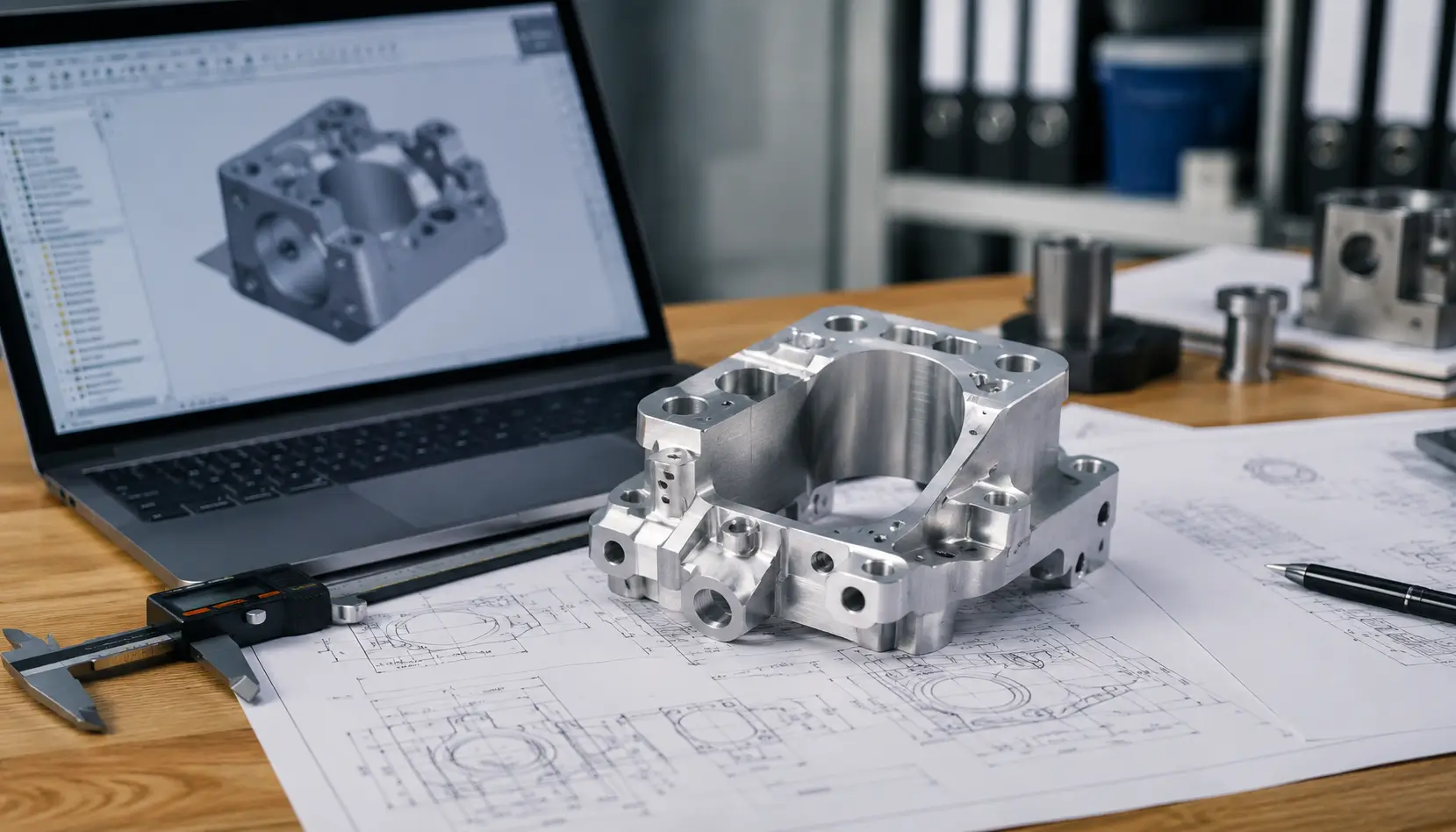
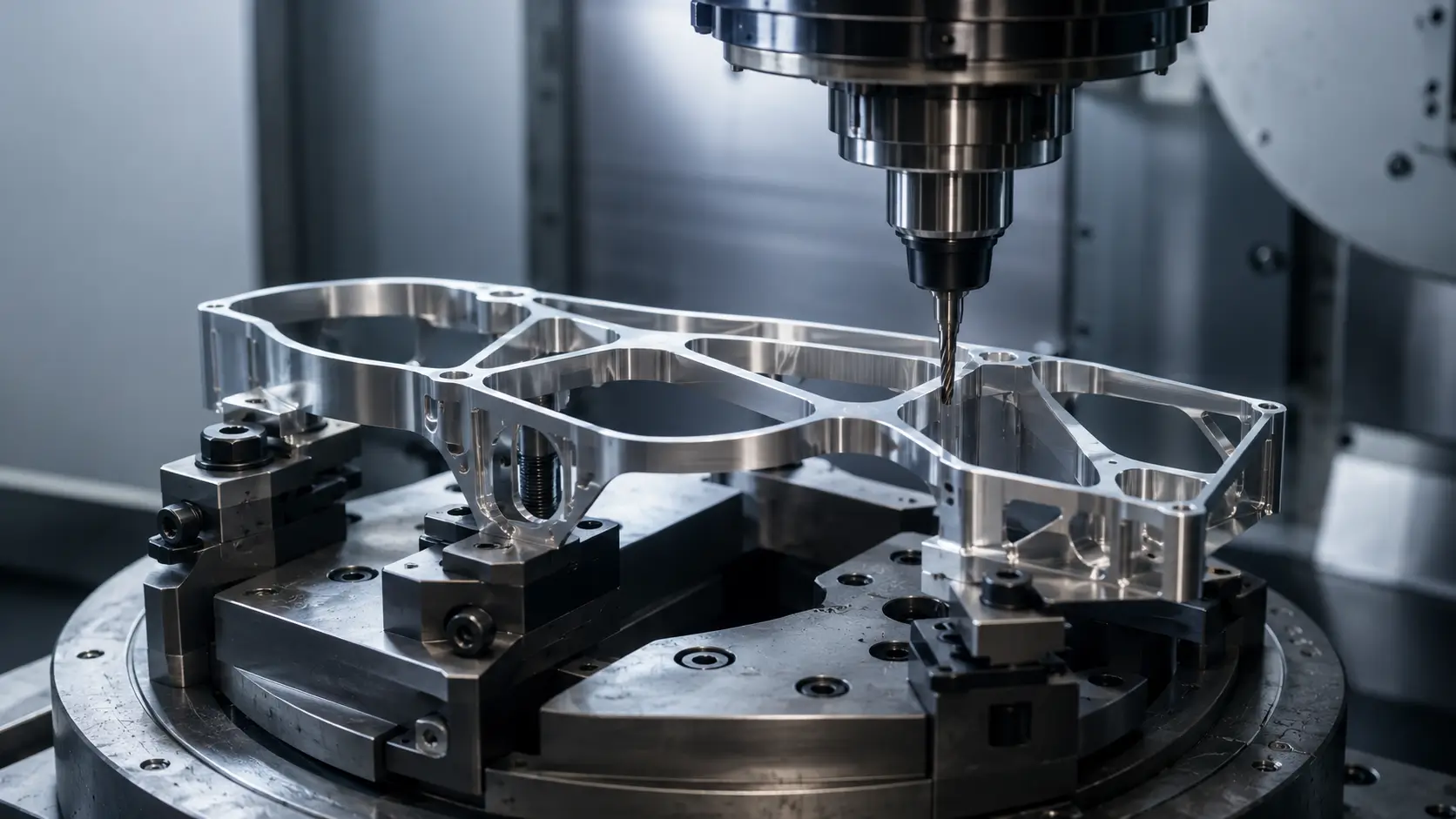
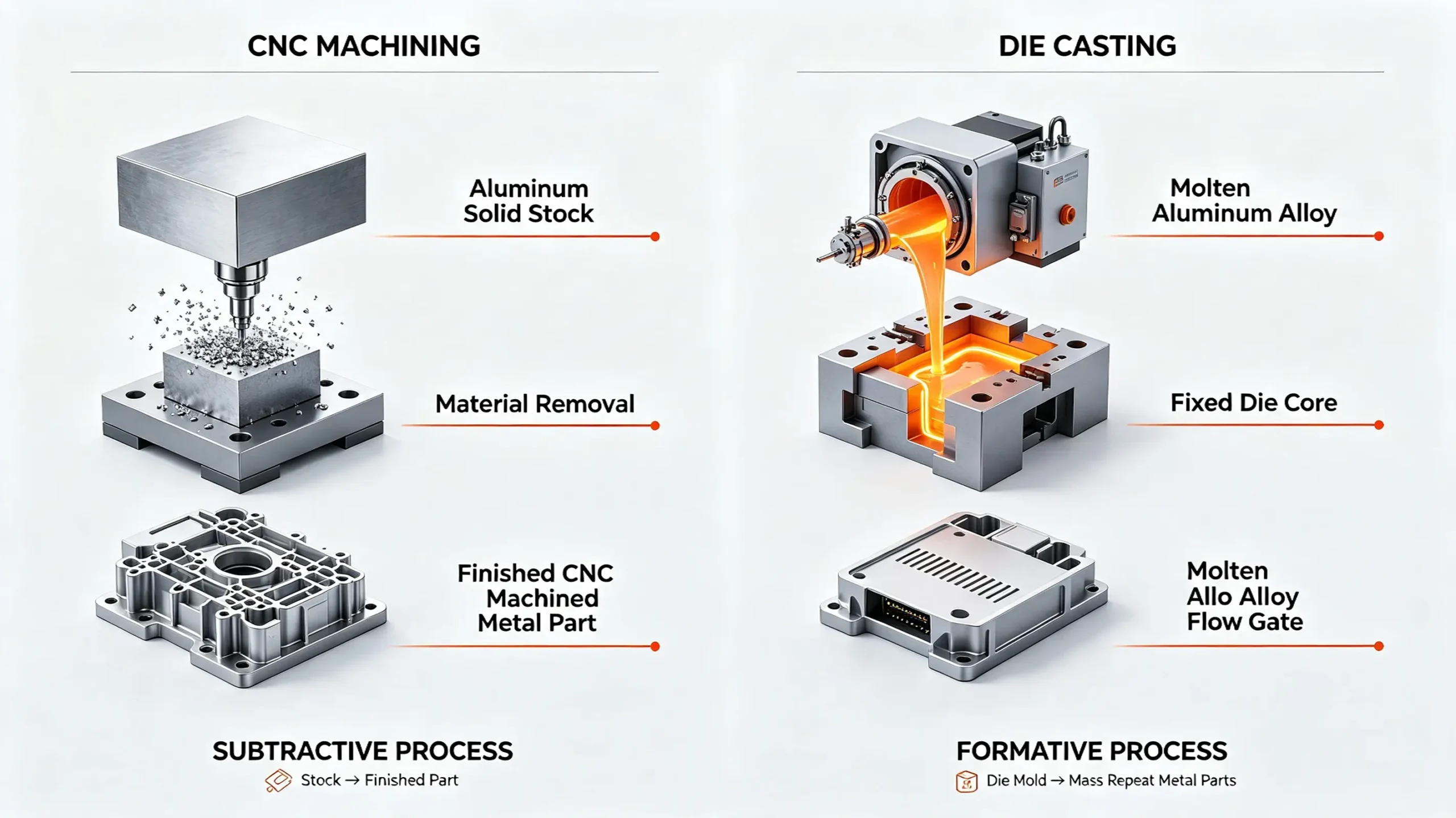
CNC machining is a subtractive process. Material is removed from a solid block, bar, or plate using rotating cutting tools until the finished geometry remains.
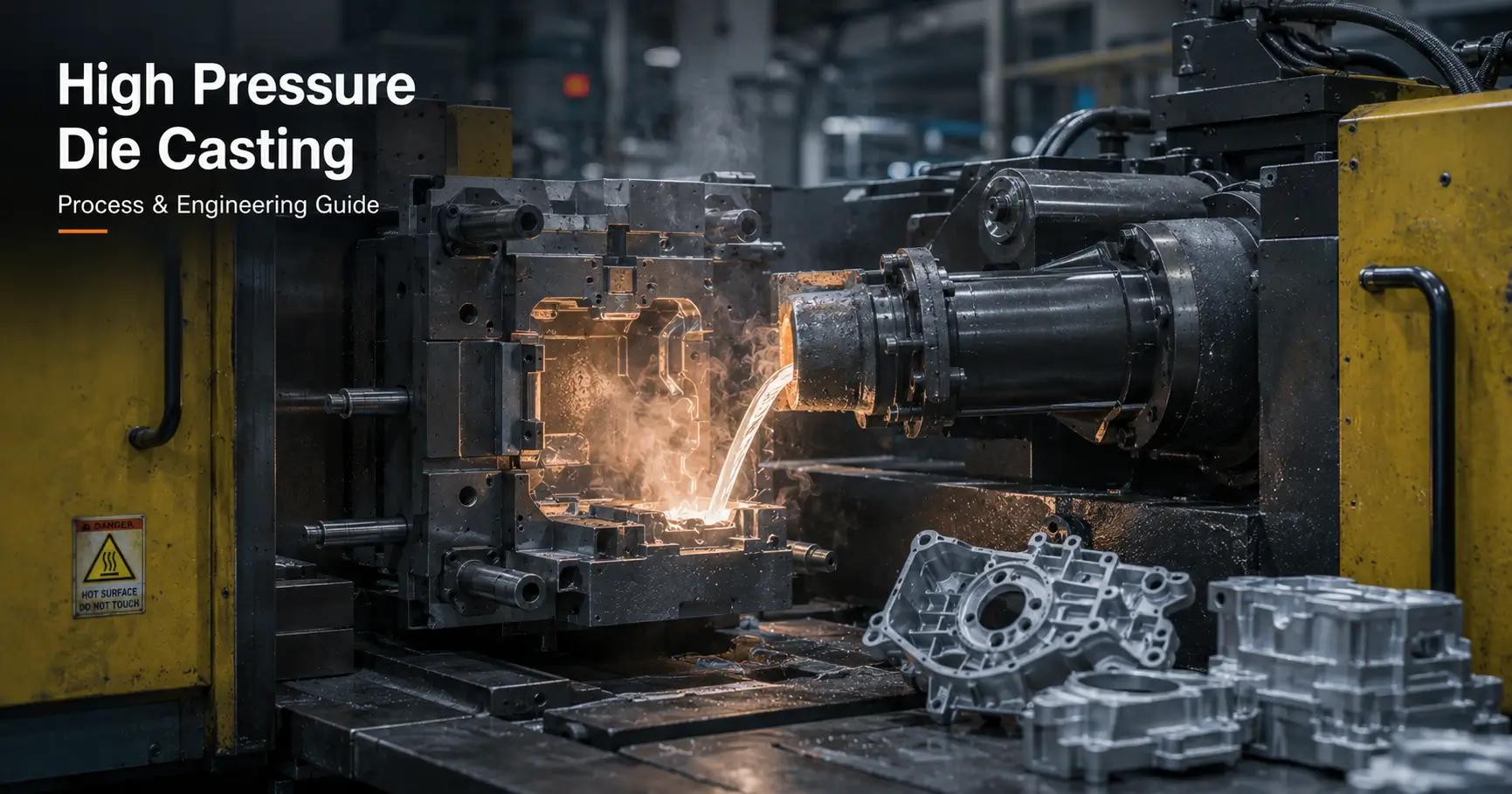
Die casting is a forming process. Molten metal is injected under high pressure into a steel mold, called a die, and solidifies into the shape of the die cavity.
This distinction determines most of the downstream differences between the two processes. CNC machining requires no tooling investment before the first part and produces a part directly from a CAD model. Die casting requires a machined steel die before any part can be produced, and that die then produces parts at high speed once it exists.
How Do CNC Machining and Die Casting Work?
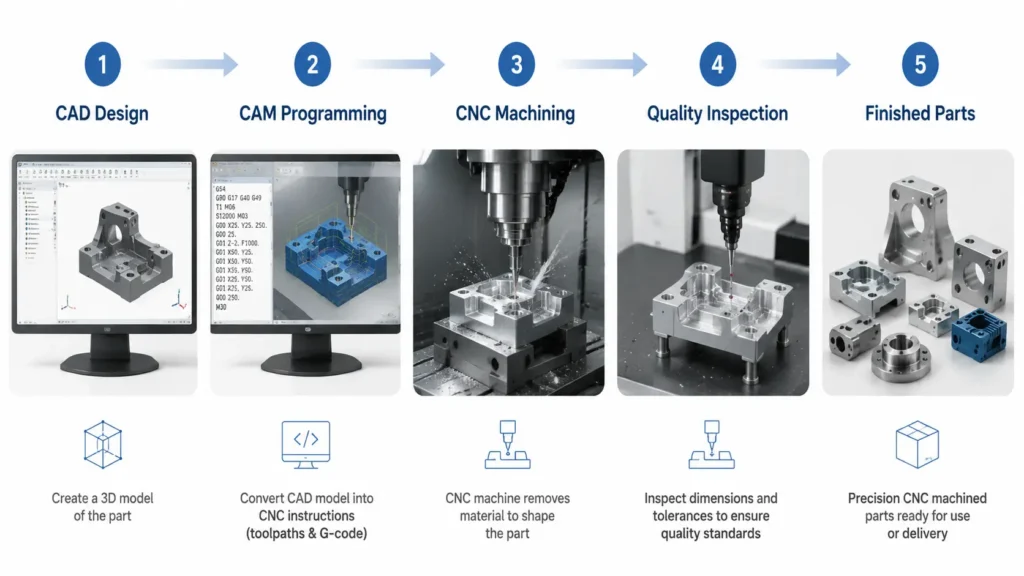
How CNC Machining Works
A CNC machine follows a programmed toolpath to remove material from a workpiece. The workpiece is held in a fixture or chuck, referred to as workholding, and a cutting tool removes material in successive passes until the finished dimensions are reached. Features that cannot be reached from the current orientation require an additional setup, in which the part is re-fixtured and re-referenced to a new set of datums.
Because material is removed rather than formed, CNC machining can produce nearly any geometry that a cutting tool can physically access, including internal features, threads, and tight-tolerance mating surfaces. The process requires no part-specific tooling, so a design change between orders only requires an updated program.
How Die Casting Works
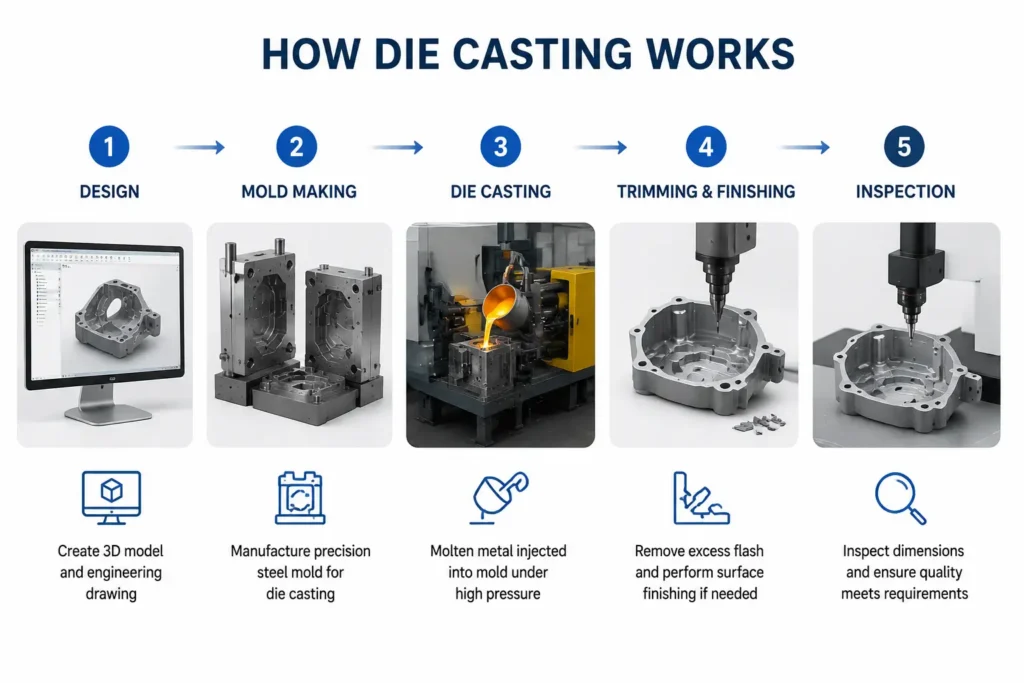
Die casting begins with a steel die machined to the negative shape of the finished part, typically split into two or more sections that separate to eject the part. Molten metal, most commonly an aluminum or zinc alloy, is injected into the die cavity under high pressure and solidifies within seconds. The die opens, the part is ejected, and the cycle repeats.
Because the die defines the part geometry, every part produced from a given die is dimensionally consistent with every other part from that die. The die itself requires significant machining time to produce and represents a fixed cost that must be recovered across the parts it produces.
CNC Machining vs Die Casting: Detailed Comparison
Materials and Part Performance
CNC machining works with a wide range of materials, including aluminum, steel, stainless steel, titanium, and engineering plastics, in wrought or bar-stock condition. Wrought material has a consistent, directional grain structure, which gives machined parts predictable mechanical properties, including in high-stress applications.
Die casting is limited to alloys with a low enough melting point and suitable flow characteristics to fill a die cavity under pressure, primarily aluminum, zinc, and magnesium alloys. Cast material can contain internal porosity from trapped gas during injection, which affects fatigue performance and can affect the part’s suitability for pressure-sealing or structural applications unless the die and process are specifically controlled for porosity.
Geometry and Design Requirements
CNC machining geometry is limited by tool access. A feature must be reachable by a cutting tool from some orientation, and features not reachable from a single orientation require an additional setup, which adds cost.
Die casting geometry is limited by mold filling and part ejection. The die must fill completely before the metal solidifies, which requires walls of a roughly consistent thickness throughout the part. The part must also release from the die without catching on an internal feature, which generally requires draft, a slight taper applied to vertical walls, on every surface parallel to the die’s opening direction. A die-cast part redesigned for machining does not need draft or uniform wall thickness; a machined part redesigned for die casting requires both.
Tolerances and Dimensional Control
| Factor | CNC Machining | Die Casting |
| Typical general tolerance | ±0.05 mm to ±0.13 mm | ±0.1 mm to ±0.3 mm, larger on features spanning the parting line |
| Tightest achievable tolerance | ±0.005 mm with grinding or jig boring | Achieved only through secondary machining of critical features |
| Tolerance consistency across a production run | High, controlled by the machine and program | Subject to die wear over the production run |
| GD&T applicability | Full range of position, profile, and form controls achievable directly | Position and profile controls on critical features typically require machining after casting |
Die casting tolerance ranges in the table above follow the NADCA standard and precision tolerance classifications, the framework used across the North American die casting industry to distinguish normal production tolerances from tighter tolerances that require additional die rigidity and process control.
A die-cast part holds tolerance well on features formed entirely within one half of the die. Features spanning the parting line, where the two die halves meet, carry a wider tolerance because die alignment and flash removal both introduce variation. A drawing with a tight positional tolerance across the parting line on a die-cast part should expect that dimension to require a secondary machining operation.
Surface Finish and Cosmetic Appearance
CNC machining produces a surface finish determined by tool path, feed rate, and finishing passes, typically in the range of 0.8 to 3.2 μm Ra as-machined, with finer finishes achievable through additional passes or secondary polishing. Tool marks are visible unless a finishing operation is applied.
Die casting produces a surface finish determined by the die cavity surface, typically in the 1 to 3 μm Ra range directly from the die, and this finish is reproduced consistently across every part from the same die. Cosmetic defects specific to die casting, including flow lines, minor surface porosity, and witness lines at the parting line, can appear on the as-cast surface and may require secondary finishing such as bead blasting or painting to meet a cosmetic specification.
Production Volume and Cycle Time
CNC machining cycle time is proportional to material removal volume and setup count, and this per-part time does not decrease significantly as order quantity increases beyond the point where fixed costs are absorbed. Die casting cycle time per part is short once the die exists, typically seconds to a few minutes depending on part size, because the die forms the entire geometry in a single injection.
This difference in cycle time behavior is the primary driver of which process is more economical at a given volume. At low quantity, CNC machining has no tooling cost to recover and remains competitive. At high quantity, the die’s fixed cost is spread across enough parts that die casting’s low per-cycle time produces a lower per-part price than machining the same part from solid stock.
Upfront Cost, Unit Cost, and Break-Even Quantity
| Factor | CNC Machining | Die Casting |
| Upfront tooling cost | None required | Die cost, ranging from several thousand to over one hundred thousand dollars depending on part size and complexity |
| Cost driver at low volume | Setup and programming (fixed, spread over few parts) | Die cost (fixed, spread over few parts) — rarely justified below several thousand units |
| Cost driver at high volume | Cycle time and material (variable, dominates per-part price) | Material and cycle time (variable, low per part once die is amortized) |
| Design change after tooling exists | Update the program; no tooling cost | Modify or rebuild the die, which adds cost and lead time |
A rough break-even point can be estimated by dividing the die cost by the per-part cost difference between the two processes. If a die costs $15,000 and machining a part from solid stock costs $12 more per part than the equivalent die-cast and machined part, the break-even quantity is approximately 1,250 units. Below that quantity, CNC machining is generally the lower-cost option; above it, die casting is generally lower cost, subject to the specific part’s material removal volume and die complexity.
Lead Time and Design Changes
CNC machining lead time is driven by programming and machine availability and typically ranges from a few days to two to three weeks, depending on part complexity and order quantity. A design change requires only a program update, so a revised part can often be produced within the same lead time as the original.
Die casting lead time includes die design and fabrication before the first part can be produced, typically four to eight weeks or longer depending on die complexity, in addition to production run time. A design change after the die exists requires modifying or rebuilding tooling, which adds both cost and lead time that does not apply to a machined part.
Material Use, Scrap, and Secondary Operations
CNC machining removes material to reach the finished shape, and the removed material becomes chips that cannot be reused in the same form. Stock utilization, the proportion of purchased stock that becomes finished part rather than chips, directly affects material cost and is lower on parts with a large difference between bounding box and finished volume.
Die casting uses material close to the finished part volume, with excess limited primarily to the runner and gate system that channels metal into the die cavity; this excess metal can typically be remelted and reused. Die-cast parts commonly require secondary operations regardless of the low material waste, including trimming the parting line flash, machining critical tolerance features, and surface finishing, so total secondary operation cost should be included when comparing the two processes.
Which Process Should You Choose?
Choose CNC Machining
CNC machining is generally the better fit for low to moderate volumes, parts requiring tight tolerances across the full geometry, materials not suited to casting such as titanium or high-strength steel alloys, and parts still undergoing design iteration where tooling cost would not be recovered before the next revision.
Choose Die Casting
Die casting is generally the better fit for high production volumes where die cost can be amortized across many parts, parts with complex external geometry that would require many machining setups to produce from solid stock, and applications where the material and tolerance requirements fall within what the die process can reliably hold.
Use Both Processes
Many parts use die casting to form the overall shape and CNC machining to finish specific features, such as bearing bores, threaded holes, or flat mating surfaces, that require tighter tolerance than the die alone can hold. This combination captures the low per-part cost of die casting for the bulk geometry while meeting tolerance requirements only on the features that need it, rather than machining the entire part from solid stock or holding the entire die to a tolerance it cannot reliably achieve. ZH Prototyping runs this combined workflow under one roof, casting the part and machining the critical features on the same production order rather than coordinating between two separate suppliers.
Conclusion
CNC machining and die casting differ in tooling requirement, tolerance capability, material options, and cost behavior across volume. CNC machining requires no tooling and holds tight tolerance across the full part, which suits low volume and iterative designs. Die casting requires a die but produces parts at low per-cycle cost once the die exists, which suits high volume production of geometrically complex parts. Break-even quantity, tolerance requirements on individual features, and material selection should be evaluated together rather than treating either process as the default choice.
Frequently Asked Questions
CNC machining removes material from a solid block to produce a part directly from a CAD model, with no tooling required. Die casting injects molten metal into a steel die to form a part, which requires the die to be built before any part can be produced.
It depends on order quantity. At low volume, die casting is rarely cheaper once die cost is included, because that cost is spread across few parts. At high volume, the die cost is amortized across enough parts that die casting typically produces a lower per-part price than machining the same part from solid stock.
Die casting typically becomes cost-competitive in the low thousands of units per part, though the exact break-even quantity depends on die cost and the machining cost of the equivalent part. You should calculate break-even using your specific part’s die quote and machining quote rather than a general volume threshold.
Yes. Machining critical features such as bores, threaded holes, and flat mating surfaces after casting is a common approach when the die alone cannot hold the required tolerance on those features.
Yes. Die casting dies are machined from tool steel using CNC milling, EDM, and grinding to produce the cavity geometry, and this die fabrication is a separate machining process from producing the die-cast parts themselves.